Holders & Transfer Tools
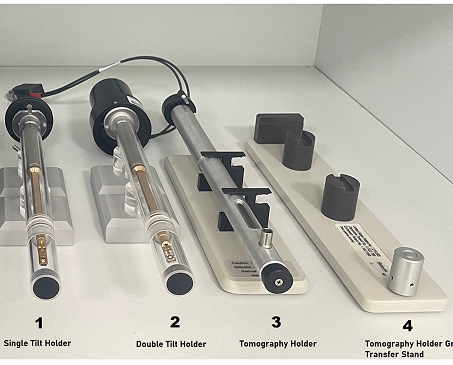
Single-Tilt Holder
Low Background Double-Tilt HiVis Holder
Compact Analytical Tomography Holder
A TEM/STEM holder designed for 3D tomography with a compact, rigid design that improves stability during long tilt-series acquisitions. It typically offers a wide tilt range (often up to ±70° or more), allowing collection of sequential images needed to reconstruct 3D structures. The “analytical” aspect means it is optimized for simultaneous imaging and spectroscopy (e.g., EDS or EELS) with minimal shadowing, enabling chemical and structural tomography.
Commonly used for materials science, nanoparticles, interfaces, thin films, and 3D compositional mapping where both high mechanical stability and full analytical access are essential.
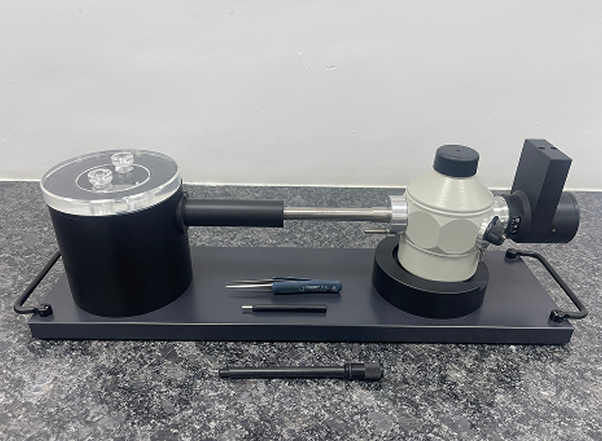
Elsa Cryo Transfer Holder
A specialized cryo-TEM holder designed to keep samples frozen at liquid-nitrogen temperatures during transfer and imaging. It preserves vitrified biological or soft-matter specimens, preventing ice crystal formation and maintaining native structure. The holder includes an insulated cryo-transfer system, anti-contamination shielding, and stable low-temperature control, enabling cryo-TEM, cryo-STEM, and cryo-EDS/EELS on temperature-sensitive samples.
Commonly used for cryo-EM of proteins and cells, polymers, hydrated materials, and any sample that must remain below –170 °C throughout preparation, loading, and imaging.
Double Tilt Liquid Nitrogen Cryo Transfer Holder – Model 915
A TEM cryo holder that allows bi-axial tilting while maintaining the specimen at liquid-nitrogen temperatures (typically below –170 °C) during transfer and imaging. Its design minimizes contamination and ice formation through an insulated cryo-transfer pathway and anti-condensation shielding. The dual-tilt capability enables precise orientation of frozen samples, improving cryo-TEM, cryo-STEM, diffraction, and analytical techniques.
Commonly used for vitrified biological samples, hydrated or beam-sensitive materials, and low-temperature studies where stable cryogenic conditions and controlled tilting are essential.